The Project
In this project, we are exploring the exotic woods present in the furniture that is part of Raby's Castle collection. Why are they classified as exotic woods? Where do these woods come from? How and when was its trade important? In which political context? The objects as well as the materials that form them tell us stories about the context in which they were made and used. In this website you will find how Amboyna, Calamander,

Illustration of Raby Castle, 1868 (Source: British Library HMNTS 10360.k.20.).
Kingwood, Rosewood, Tulip wood, and Zebra wood answer to the questions asked and evidence the territories colonised during the late 18th and early 19th century by the British crown. First we are going to understand the term exotic in this period, then through the map that shows the possible commercial routes, we will explore the biography of each wood and how they end up as a European design in Raby Castle.
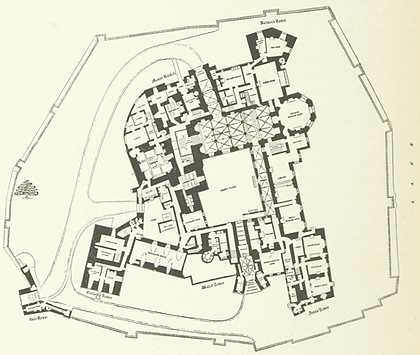
Floor plan of Raby Castle, 1897 (source: 'The Castles of England: their story and structure ... With ... illustrations and ... plans', by James Dixon Mackenzie (British Library HMNTS 10369.v.7).

Continental purplewood and marquetry table, Raby Castle
What is Exotic Wood?
First let's talk about the term exotic and how it impacts the wood trade during the late 18th early 19th century. Based on the Oxford English Dictionary the term “exotic” means “Originating outside a particular place, system, etc.” however, the term cannot be seen solely as such. During the early modern period this term was accompanied by the European colonization of territories in different continents, including America, Africa and Asia, exploiting the natural resources of these territories, enslaving native people of these territories as well as the African enslavement trade, and imposing European traditions on these groups of people, among many other things.
Particularly with the arrival in America, the European colonisers in their wonder for the “New World," decided to explore the continent recording their experiences in letters, diaries, drawings, and collecting specimens to carry to Europe evidence of “new” sources for its use, trade, and private collection. Surrounded by mystery and driven by curiosity, the collection of unknown sources and objects became prevalent in Europe, classifying them under the terms Naturalia (made by nature) and Artificialia (made by human) in the Cabinets of Curiosities. In each category we can find the term exotica registered in inventories of these collections. Daniela Bleichmar, studying various documents that register the Spanish Vincencio Juan de Lastanosa’s collection, argues that “these documents attest to the presence in the collection of many objects characterised as ‘‘exotica,’’ that is, marked by their distant origin in nonEuropean lands.”

Photo by Dave Hoefler on Unsplash.
The first record of “exotick” found in 1599 Oxford English Dictionary, defined the word related to magic and witchcraft; by 1646, this word acquired the foreign origin connotation. In 1876 the word ‘‘exotica’’ was used for the first time in English records. Under this view, the British Empire exploited natural resources in distant non-European lands such as America and the Caribbean region, West coast of Africa, and India. One of the natural sources exploited from these territories was wood, initially because its weight was needed to balance the vessel in the shipping of other resources such as sugar, tobacco, cacao, and others. However, in a short time the wood became an important product in the trade. The introduction of a variety of commodities in Britain was due to colonisation of territories, political events, and also, changes in fashion. Although “exotica” was a term that came after the creation of Raby Castle furniture, it perfectly defines the wood of the furniture studied, since they all come from distant territories colonised by the British crown.

Johann Moritz Rugendas, Derrubada de uma floresta (Devastation of the jungle), c. 1820 - c. 1825. Illustration showcasing the use of slave labour for forest work in Brazil.
Furniture Collecting at Raby Castle
Raby Castle was built in the fourteenth century by the Neville family, maintaining the traditional medieval style of the period. The castle was confiscated by the crown in 1569, and purchased in 1626 by Sir Henry Vane the Elder[1] whose family still owns the property. Since then the castle has had three main restoration periods. The first, led by the 3rd Lord Barnard (1st Earl of Darlington) and under the guidance of the architect James Paine, restored the interior of the south and west wings of the castle. The second restoration period, led by the 2nd Earl of Darlington (4th Lord Barnard) and directed by the architect John Carr, involved the project in 1768, constructing the Entrance Hall, a round tower on the south front, and restoring other parts of the interior and exterior of the castle. Finally, the 2nd Duke of Cleveland (6th Lord Barnard) hired the architect William Burn in 1843, who worked in the south front and the Octagonal Drawing Room.[2]

Bill from Matthew Thompson, invoice 9th September 1844, Raby Castle Archives, bundle 1025/2/3
All along these restorations and constructions, different styles were implemented in the rooms and towers, interiors and exteriors of Raby Castle. In this sense the furniture complemented the stylistic decisions of each space, moving them from one room to another or commissioning new ones for different areas of the castle.
Of particular interest to us, is the third restoration period, which frames the furniture studied in this project and most of the actual furniture collection of the Castle. This period is a clear example of the nineteenth century historicism in which through the archaeological expeditions various European countries decided to revive styles from their national past or international interests, such as the Rococo and Gothic revival, both framed also under political events. A clear example is the Small Drawing Room, which was completely altered in 1820 to become a Regency room example, or the Dining Room reconstructed in a Victorian style. Being a stylistically prolific period for the restoration of the castle, below we will recount the interests of the 2nd Duke of Cleveland in this period and how they are reflected in his property.
[1]For more details consulate the Raby Castle Guidebook. Robert Innes-Smith, Raby Castle. Official Guidebook, (Durham: Jarrold Publishing, 2025), 5.
[2]Innes-Smith, Raby Castle, 5-9.
Henry Vane, 2nd Duke of Cleveland
Much of the collection of exotic woods at Raby Castle was facilitated by Heny Vane, 2nd Duke of Cleveland, who was owner between 1842-1864. He Commissioned high-quality furniture from leading British cabinetmakers, including Gillows of Lancaster, Holland & Sons and Morant. This included the commission for decoration and furniture for the Octagon Room in 1848.
Vane was the child of William Vane, 1st Duke of Cleveland (1766–1842) and Katherine Powlett, daughter of Harry Powlett, 6th Duke of Bolton. In 1809 he married Lady Sophia Poulett, daughter of John Poulett, 4th Earl Poulett. The couple had no children, so after his death the title 'Duke of Cleveland' passed to his brother.
