Calamander
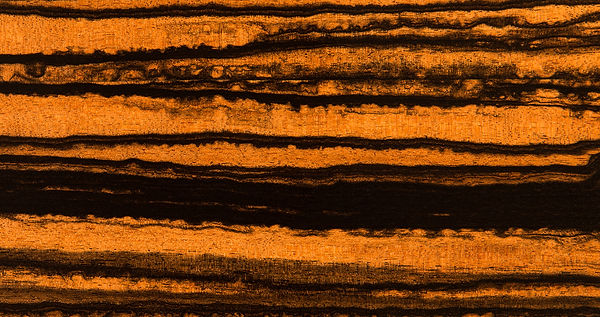
Calamander wood, from the Diospyros family, a variegated ebony, is endemic to Sri Lanka.[1] It is a hard and heavy wood, whose appearance in a transversal cut shows its fibers as stripes intercalated between yellow-orange and dark brown colors. Because of its contrasting colours the wood became fashionable in 1800, making Brazilian rosewood, zebrawood, coromandel and calamander the most used examples.[2] Calamander wood was frequently used in Regency furniture as veneer due to its high price in the market.
Adam Bowett explains that from the second half of the 18th century onwards Britain gradually ousted French influence “from eastern India, moving south from Bengal to control all the Northern Sarkars by 1783. Control of the southern Carnatic, which included the Coromandel coast, was finally secured by Sir Arthur Wellesley’s victory over Tipu Sultan in 1799. Ceylon (now Sri Lanka) was wrested from the Dutch in 1796 and was formally ceded to Britain by the Treaty of Amiens (1802).”[3] As a result, British trade with southern India and Ceylon increased leading to the availability of different commodities, such as calamander wood.
Calamander wood was confused with coromandel wood, another ebony wood from India. However in the second quarter of the 19th century “British botanists working in India and Ceylon began to identify the particular species producing variegated ebony.”[4]
Routes:
From the Coromandel coast and Sri Lanka.
[1] Adam Bowett, “Calamander and Coromandel,” in Woods in British Furniture Making 1400-1900, (London: Royal Botanic Gardens, 2012), 48.
[2]Bowett, “Calamander and Coromandel,” 49.
[3]Bowett, “Calamander and Coromandel,” 48-49.
[4]Bowett, “Calamander and Coromandel,” 50.