Zebrawood
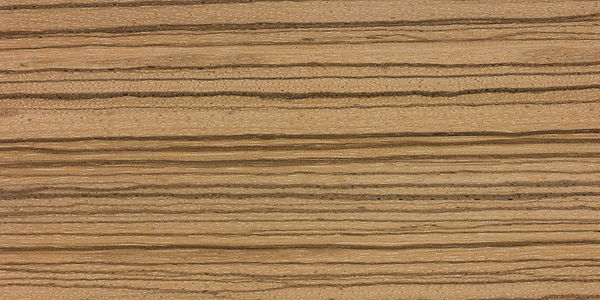
Zebra wood, from the Astronium family, is widely distributed in Central America, Colombia, Venezuela, the Guianas, Trinidad and especially Brazil,[1] as well as some territories of west Africa. The appearance of this wood in a transversal cut looks like streaks of beige light yellow tone with thin dark brown fibers all along the piece. The tree reaches more than 30m in height, and more than 90cm in diameter. It is a hard wood and heavy, with fine texture, easy to work and takes a high polish.[2]
In 1655 the British took Jamaica from the Spanish colonisation, and the island was principally used to create sugar plantations. In the second half of the 18th century, 1774, the explorer Edward Long wrote in History of Jamaica, 8th chapter of the 3rd book, about the natural products of the island proper for exportation. Here Long describes the zebra wood as a hard wood that grows specially in the mountains, “bears a good polish, and its beautifully striped and clouded.”[3] It was brought to Jamaica from the Mosquito Shore, actually Honduras, and is a good product for export specially for cabinet making.[4]
By the 1770s the importation to Britain of zebra wood continued either “direct from Honduras and the Mosquito Shore, or via West Indian and North American ports, until halted by the entry of Spain into the American Revolutionary War in 1779.”[5] The same year, the Spanish attack on the British settlements in the Bay of Honduras caused the cessation of timber exports to Britain.[6] However, zebra wood trade resurfaced in the early 19th century due to the Anglo-Portuguese Trade Treaty of 1808, “by which British ships were for the first time allowed to trade directly with Brazil”[7]. During this period zebra wood was used both as a veneer and as a solid wood. This wood was mentioned in January 1812 by Bullock advertisement in the Liverpool Mercury, and was also listed in 1819 Bullock’s stock-in-trade.[8]
Routes:
Most was imported from Brazil and small quantities from Portugal.
[1] Adam Bowett, “Zebra wood,” in Woods in British Furniture Making 1400-1900, (London: Royal Botanic Gardens, 2012), 269.
[2] Bowett, “Zebra wood,” 269.
[3] Edward Long, The History of Jamaica or, a General Survey of the Antient and Modern State of that Island: with reflections on its Situation, Settlements, Inhabitants, Climate, Products, Commerce, Laws, and Government, Vol. III (London: Lowndes, in Fleet-Street, 1774), 837.
[4] Long, The History of Jamaica, 837.
[5] Bowett, “Zebra wood,” 269.
[6] Bowett, “Zebra wood,” 269.
[7] Bowett, “Zebra wood,” 269.
[8] Bowett, “Zebra wood,” 269.